

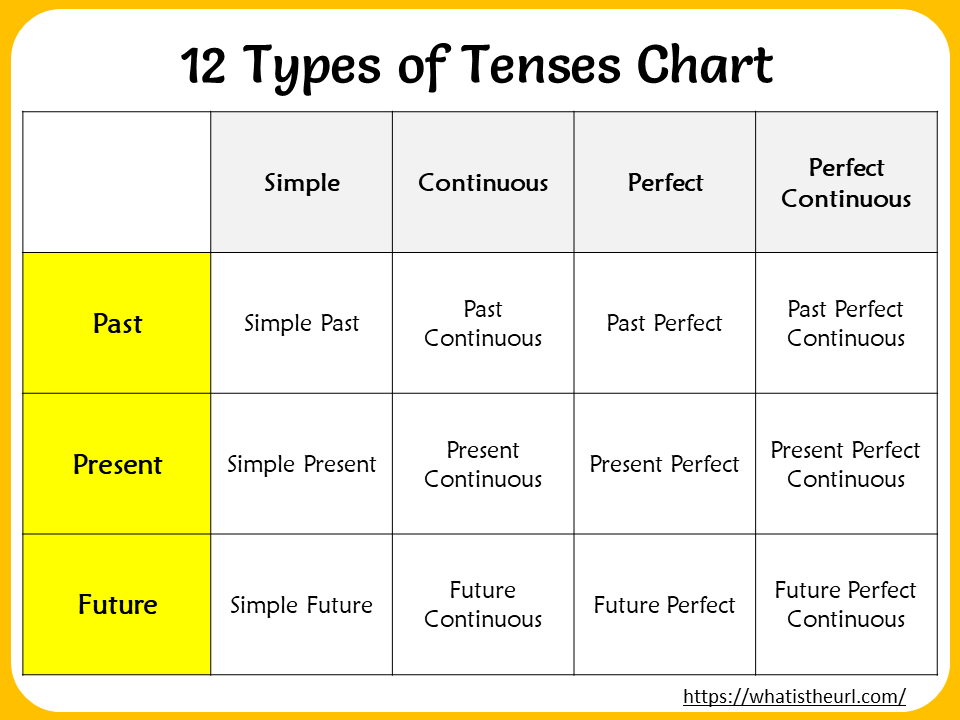
Mastering English grammar starts with a solid knowledge of tenses, which are crucial for expressing time in language. Whether you’re a pupil, a teacher, or truely looking to improve your communication skills, know-how the stressful chart can offer you with a clearer photo of methods verbs change based totally on time.
In this article, we are able to discover the idea of the demanding chart without imparting it in a desk layout. Instead, we’ll damage it down in a descriptive and smooth-to-understand way, protecting the key styles of tenses and their subcategories.
What Is a Tense?
Tense refers to the form of a verb that suggests the time of an motion or occasion. In English, tenses are typically labeled into 3 primary kinds:
- Present Tense
- Past Tense
- Future Tense
- Each of these is similarly divided into 4 components:
- Simple
- Continuous (also referred to as Progressive)
- Perfect
- Perfect Continuous
- Altogether, there are 12 tenses in English grammar.
Present Tense Forms
Simple Present
Used for conduct, favored truths, and repeated moves.
Example: She walks to high school each day.
Present Continuous
Describes movements going on now or across the modern-day time.
Example: He is reading for his assessments.
Present Perfect
Used at the same time as an motion has tense chartpassed off at an unspecified time earlier than now.
Example: They have finished their homework.
Present Perfect Continuous
Shows an movement that commenced inside the beyond and continues to be persevering with.
Example: I had been working considering that morning.
Past Tense Forms
Simple Past
Refers to a completed action in the beyond.
Example: She visited Paris closing summer time.
Past Continuous
Describes an motion that have become ongoing inside the past.
Example: I became looking TV whilst you known as.
Past Perfect
Used even as one past motion happened earlier than every other.
Example: He had left earlier than I arrived.
Past Perfect Continuous
Emphasizes the duration of a beyond movement that became happening in advance than something else.
Example: We have been searching beforehand tense chart to hours in advance than the show started out.
Future Tense Forms
Simple Future
Used for actions on the manner to arise within the destiny.
Example: She will call you the next day.
Future Continuous
Describes an movement in an effort to be in development at a positive time in the future.
Example: I will be attending the assembly at 3 PM.
Future Perfect
Indicates that an motion will have been finished through a certain point within the destiny.
Example: They will have completed the mission by way of Friday.
Future Perfect Continuous
Focuses on the duration of an movement up to a degree in the destiny.
Example: By next month, he will have been working proper here for five years.
Why Is the Tense Chart Important?
Understanding all 12 tenses via the idea of a demanding chart enables freshmen:
- Express moves simply in awesome timeframes
- Improve writing and speaking fluency
- Understand time relationships amongst a couple of actions
- Prepare for aggressive exams and professional communication
How to Master the Tense System
- Practice Daily: Use exclusive tenses in your writing and speech.
- Read and Listen: Pay interest to how neighborhood speakers use tenses.
- Use Real Examples: Write quick stories or journals to evidently practice.
- Get Feedback: Work with a trainer or language partner to correct mistakes.
Final Thoughts
Though we frequently take a look at tense chart with the demanding chart to understand verb paperwork and time expressions, memorizing the chart on my own isn’t always enough. The key’s in know-how the context, practicing frequently, and using what you have located out in actual-international conversations. By breaking down tenses into easy elements as we’ve finished right here, even novices can get a firm preserve near of the way English tenses work.


