

Let’s be honest — when you’re shopping for something that’s supposed to last forever, a little confusion is totally normal. Especially when the sparkle is real, the price is right, and both options claim to be ethical, stunning, and “just like the real thing.” So here’s the big one:
Moissanite diamond or lab made diamonds — which one is actually better?
Well, that depends on what “better” means to you. Because while they might look similar from a distance, these two gems couldn’t be more different once you get up close. Let’s break it down in a way that actually makes sense — no heavy gemological jargon required.
Wait, What Even Is a Moissanite Diamond?
Short answer: it’s not a diamond. The name “moissanite diamond” is kind of misleading. It’s like calling oat milk “milk” — close enough for conversation, but technically… not the same thing.
Moissanite is its own gemstone. Originally discovered in a meteor crater (yes, seriously), it’s made of silicon carbide and is now created in labs. That’s part of its charm — it looks diamond-like but has its own personality.
On the other hand, lab made diamonds are actual diamonds, just grown in a lab instead of mined from the earth. Same chemical structure. Same physical properties. Same sparkle — just a whole lot less drama. So, no — moissanite isn’t a “fake” diamond. But it’s definitely a different stone.
The Tale of Two Sparkles: What Sets Them Apart
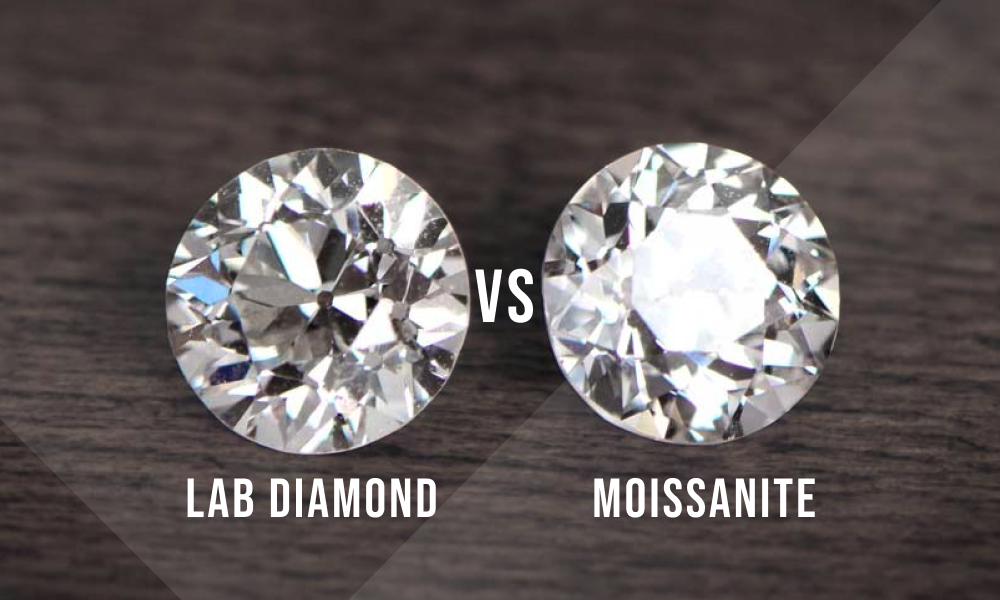
Let’s get visual here. You’ve got a ring in each hand. One features a moissanite diamond, the other a lab made diamond. Both are gorgeous. But what’s really going on?
Brilliance & Fire
Moissanite has more fire (that rainbow-y sparkle) and brilliance than even a diamond. It flashes like crazy in the light — some people love that. Others think it looks a bit “too much.”
Lab made diamonds have that classic, sharp sparkle we all associate with diamonds. Less rainbow, more clean flash. If you’re going for traditional diamond vibes, this one’s the winner.
Hardness & Durability
On the Mohs scale:
- Lab made diamonds = 10 (the hardest known material)
- Moissanite = 9.25 (still extremely durable)
In short? Both are strong enough for everyday wear. But diamonds take the lead for scratch resistance — barely.
Price Point
Here’s where moissanite really wins. You can get a 2-carat moissanite that looks almost identical to a 2-carat lab made diamond for a fraction of the price.
Think:
- Lab made diamonds: £1,500–£3,000+ (depending on cut, clarity, etc.)
- Moissanite: £500–£1,000 (for a seriously high-quality one)
So if budget is a top concern, moissanite might just be your BFF.
What’s Trending: Who’s Buying What?
Let’s face it — people are getting smarter about their jewellery.
More couples are skipping the traditional mined diamond altogether. And with lab made diamonds and moissanite both on the rise, here’s what we’re seeing in the wild:
Moissanite Lovers:
- Want max sparkle for less money
- Love that it’s ethically made and low-maintenance
- Don’t mind if it’s not technically a diamond
Lab Diamond Devotees:
- Want a “real” diamond look and feel
- Care about resale value (lab diamonds hold some, moissanite doesn’t really)
- Prefer a more classic, less flashy sparkle
Still torn? You’re not alone. Some people even choose moissanite for the centre stone, and lab diamonds for side accents. Smart and sparkly.
The UK Jewellery Scene: What’s the Local Buzz?
In the UK, things are catching up fast with the US.
You’ve got more online jewellers (and some bold high-street names) offering lab made diamonds and moissanite engagement rings, wedding bands, earrings — you name it.
Why now?
A few reasons:
- Ethical shopping is finally mainstream
- People want bigger stones without bigger credit card bills
- COVID-era savings meant people started looking at alternative stones while shopping from home
Fun fact: Some UK jewellers now specialise only in lab grown or moissanite pieces. No mined diamonds at all. That was basically unheard of five years ago.
Behind the Scenes: How Are They Made?
Let’s geek out for a second. This stuff’s actually pretty cool.
Lab Made Diamonds
Made using HPHT (High Pressure, High Temperature) or CVD (Chemical Vapor Deposition). Basically? Scientists recreate the extreme conditions that form diamonds naturally — but in a lab. The result? A real diamond. Full stop.
Moissanite
Also lab-created, but made from silicon carbide crystals. It takes less time to grow, which is why it’s cheaper. But it’s not trying to be a diamond — just to look kinda like one.
So yeah, both are lab-grown. But only one is technically a diamond.
Real Talk: Which One Should You Buy?
Here’s the honest answer: it depends on what matters most to you.
Ask yourself:
- Do I want a real diamond, but with a lower price and less guilt?
→ Go with lab made diamonds. - Do I care more about size, sparkle, and budget than traditional value?
→ Moissanite diamond is your new best friend. - Want to stay under a certain price point without looking like it?
→ Moissanite’s hard to beat. - Do I want something that feels exactly like a mined diamond?
→ Lab made diamonds win here.
Either way, you’re making an ethical, modern choice — and that alone puts you miles ahead of traditional shoppers.
There’s No “Wrong” Choice
At the end of the day, both moissanite diamonds and lab made diamonds are part of a jewellery revolution — one that prioritises ethics, affordability, and transparency.
They’re for people who think a little deeper. Spend a little smarter. And still want something gorgeous on their finger.
So whatever you choose, make it yours. And remember: It’s not about what other people think — it’s about what sparkles for you.


